Tutorials and Webinars
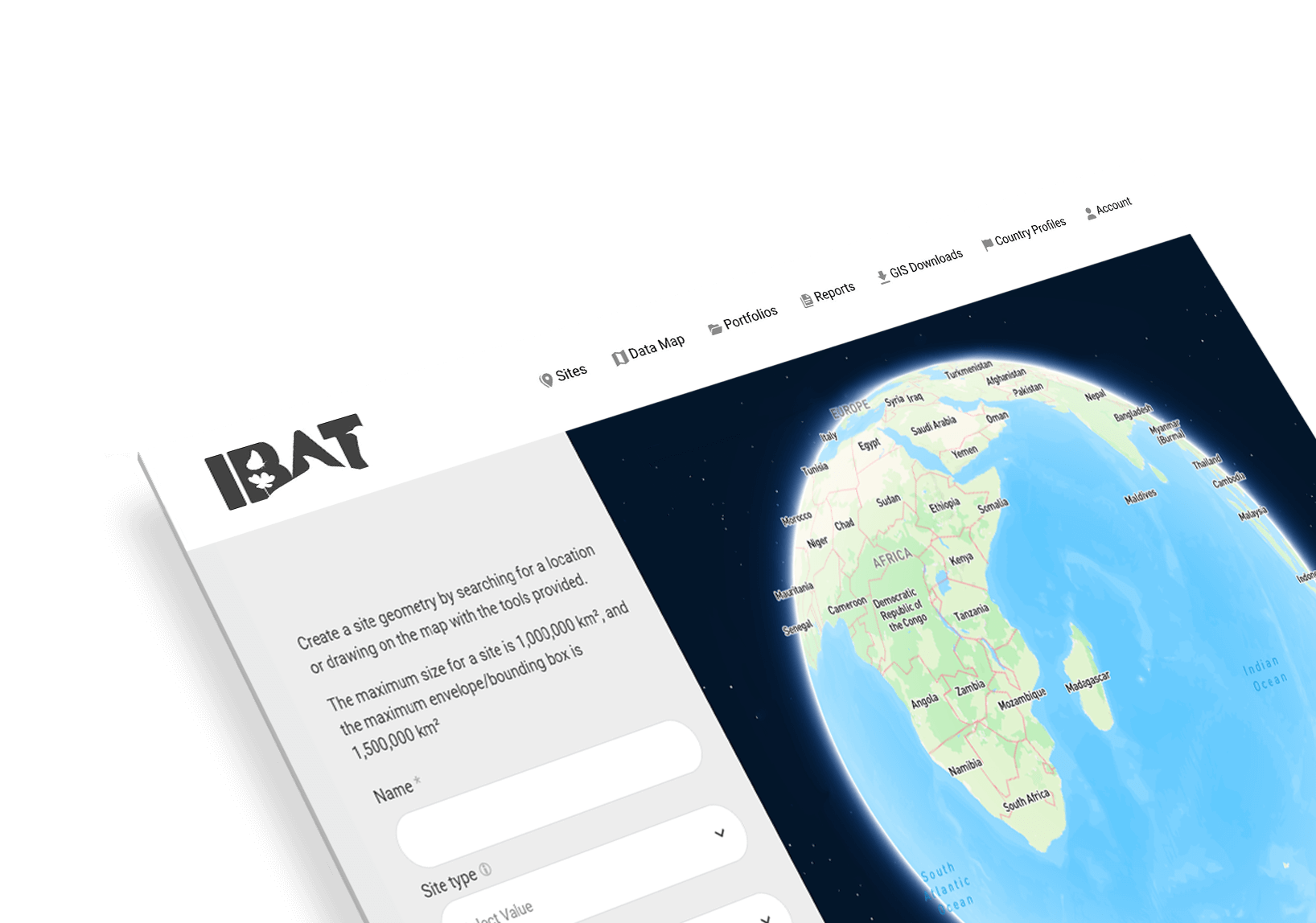
Our tutorials and webinars are designed to support you in navigating the IBAT platform. Tutorials provide clear, step-by-step guidance, while webinars offer valuable insights, updates, and expert-led discussions.
To better serve our global community, some content is available in Spanish, with additional languages planned in future to further enhance accessibility.
IBAT Overview
Understand IBAT's functionality and features. Get an insight into the datasets that make up IBAT, how to use that data to assess your organisation’s sites, and learn about the reports that are available through IBAT, such as Disclosure Preparation (TNFD, GRI) and Proximity Reports.

IBAT Tutorial Video: The Disclosure Preparation Report
In this video tutorial, we'll explore how the IBAT tool can be aligned with key global biodiversity regulations, frameworks, and standards, and we'll also take a deep dive into one of its most powerful features: the Disclosure Preparation Report, or DPR.
IBAT is referenced across major sustainability frameworks like the European Sustainability Reporting Standards (ESRS), the Taskforce on Nature-related Financial Disclosures (TNFD), and the Global Reporting Initiative (GRI), providing users with trusted data to report with confidence.
It helps organisations quickly understand biodiversity risks and impacts with site-based screening and clear metrics.
The DPR is a comprehensive report designed to compile essential biodiversity information for a portfolio of up to 1000 sites. Beyond it's alignment with TNFD, GRI and ESRS, the report can be used for early-stage risk screening and prioritisation of sensitive locations.
Recording IBAT webinar: How to navigate biodiversity reporting - Session 1
In this session we explore the current biodiversity reporting landscape, including key regulatory frameworks such as TNFD, CSRD and GRI, and demonstrate how authoritative biodiversity data can support robust, credible disclosures.
This webinar features a presentation from Lee Bing Yi, Partner, Sustainability & Climate Change, at PwC Singapore.
Participants will gain practical insight into:
• The biodiversity reporting landscape and frameworks (TNFD, CSRD, GRI)
• The role of authoritative biodiversity data and insights in supporting credible and consistent disclosures• How IBAT helps organisations identify biodiversity risks, opportunities and make informed decisions to support their nature-positive goals
• Seeing an example of how to apply biodiversity data for reporting, disclosure and decision-making
• A practical walkthrough of IBAT’s Disclosure Preparation Report (DPR)The session includes a live Q&A with the IBAT team.
Speakers:
Jake Tatum, Outreach Officer, IBAT
Megan Sim, Programme Officer, IBAT
Lee Bing Yi, Partner, Sustainability & Climate Change, at PwC Singapore
Gonzalo Gomez, Programme Officer, IBAT
Recording IBAT webinar: How to navigate biodiversity reporting - Session 2
In this second session we explore the current biodiversity reporting landscape, including key regulatory frameworks such as TNFD, CSRD and GRI, and demonstrate how authoritative biodiversity data can support robust, credible disclosures.
This webinar features a presentation by Carlijn van Dam, Senior Manager nature and biodiversity at KPMG International.
Participants will gain practical insight into:
• The biodiversity reporting landscape and frameworks (TNFD, CSRD, GRI)
• The role of authoritative biodiversity data and insights in supporting credible and consistent disclosures
• How IBAT helps organisations identify biodiversity risks, opportunities and make informed decisions to support their nature-positive goals
• Seeing an example of how to apply biodiversity data for reporting, disclosure and decision-making
• A practical walkthrough of IBAT’s Disclosure Preparation Report (DPR)The session will conclude with a live Q&A with the IBAT team.
Speakers:
Jake Tatum, Outreach Officer, IBAT
Carlijn van Dam, Senior Manager nature and biodiversity at KPMG's Global Climate, Decarbonization and Nature Hub, KPMG International
Mark Leckie, Programme Officer, IBAT
Gonzalo Gomez, Programme Officer, IBAT
Webinar recording: A Deep Dive into the IBAT Species Report
A deep dive into the IBAT Species Report and an Introduction to the IUCN RHINO (Rapid High-Integrity Nature-positive Outcomes) approach and STAR (Species Threat Abatement and Restoration Metric).
During this webinar you'll gain:
• An understanding of how the IUCN RHINO approach guides companies on what to do, where to act, and how to measure progress towards Nature Positive outcomes
• Insights into how STAR is developed and how it can be used to quantify reductions in extinction risk
• Knowledge of relevant IBAT products and how organisations can apply IUCN RHINO and STAR in their own conservation planning
Speakers:
Jake Tatum, IBAT Outreach Officer
Florence Curet, IUCN Senior Programme Manager
Thomas Starnes, IUCN Senior Programme Officer
Warwick Mostert, IBAT Biodiversity and Business Lead
Mark Leckie, IBAT Programme Officer
Recording - Seminario IBAT: Apoyo a la acción empresarial en favor de la biodiversidad
En este seminario, Gonzalo Gomez, Programme Officer de IBAT, presenta la Herramienta Integrada de Evaluación de la Biodiversidad (IBAT) y su papel en apoyar a las empresas a tomar acciones positivas para la naturaleza.
IBAT apoya al cumplimento de las metas del Marco Global de Biodiversidad de Kunming-Montreal, y contribuye a detener la extinción de las especies y divulgar impactos empresariales en la naturaleza en relación con las normas y marcos globales de sostenibilidad.
Navigating Nature Related Risks: A Complementary Approach to Biodiversity Assessment Tools Webinar
The pressure on organisations to assess their nature-related impacts is growing, driven by market demands and an increasing number of regulations, frameworks, and standards. In this evolving landscape, understanding and assessing an organisation's biodiversity-related risks is crucial.
You might be asking: "With multiple biodiversity assessment tools available, how do they differ, and how can we use them together effectively?"
This webinar will aim to address that question. We'll equip you with a clear understanding of different biodiversity assessment tools, including IBAT, ENCORE, and WWF Biodiversity Risk Filter. You'll learn about their individual functionalities and gain practical insights into how you can use them in a complementary manner to support robust nature-related risk analysis and decision-making.
Join our speakers from IBAT, UNEP-WCMC, and WWF for this insightful session and get your questions answered.
Navigate Nature-Related Reporting with IBAT’s Disclosure Preparation Report
Using the report, organisations can assess if their sites are located in or near sensitive areas in alignment with the different definitions provided by the TNFD, GRI and ESRS (based on the IBAT datasets). Sites assessed as in or near sensitive areas are then given a significance score to aid the prioritisation of these sites. The report also provides guidance on buffers to be applied to different site types, analysis based on the operation type across an organisation’s value chain and outputs from IBAT which can be used for the specific disclosure requirements of ESRS, TNFD and GRI.
KBAs: Identifying the right places for protecting biodiversity
This video explains what KBAs are and why they are critical for ensuring that protection occurs in the right places. The world is discussing expanding protection to 30% of the planet by 2030 in order to halt biodiversity loss - but if the 30% is not well placed it will likely have minimal impact.
Understanding KBAs
Key Biodiversity Areas (KBAs) are the most important places in the world for species and their habitats.
By providing these data through IBAT, commercial users, private industry and other stakeholders can make the best decisions about how to manage land (or waters), where to avoid development, and how best to conserve and protect the animals and plants for which the sites are so important.


Learn how IBAT can transform your relationship with data and support your nature-positive goals